


How civil tender evaluation NSW should start
Compare proposals against the same civil tender requirements first—scope map, programme response, listed assumptions, and named project delivery controls—then look at price. Lowest lump sum without shared assumptions is not evaluation; it is luck ranking.
Civil tender evaluation NSW fails when clients score plant lists and brochure photos while exclusions differ between tenderers. Force every return to answer the same gates before you negotiate rates.
If your brief is still incomplete, strengthen the inquiry pack using what to include in a civil project inquiry so evaluating teams are not guessing missing drawings. When you are ready to test delivery capacity against a live package, review NEXTGEN civil infrastructure capabilities before you finalise the tender panel.
Build a civil contractor checklist that scoring can actually use
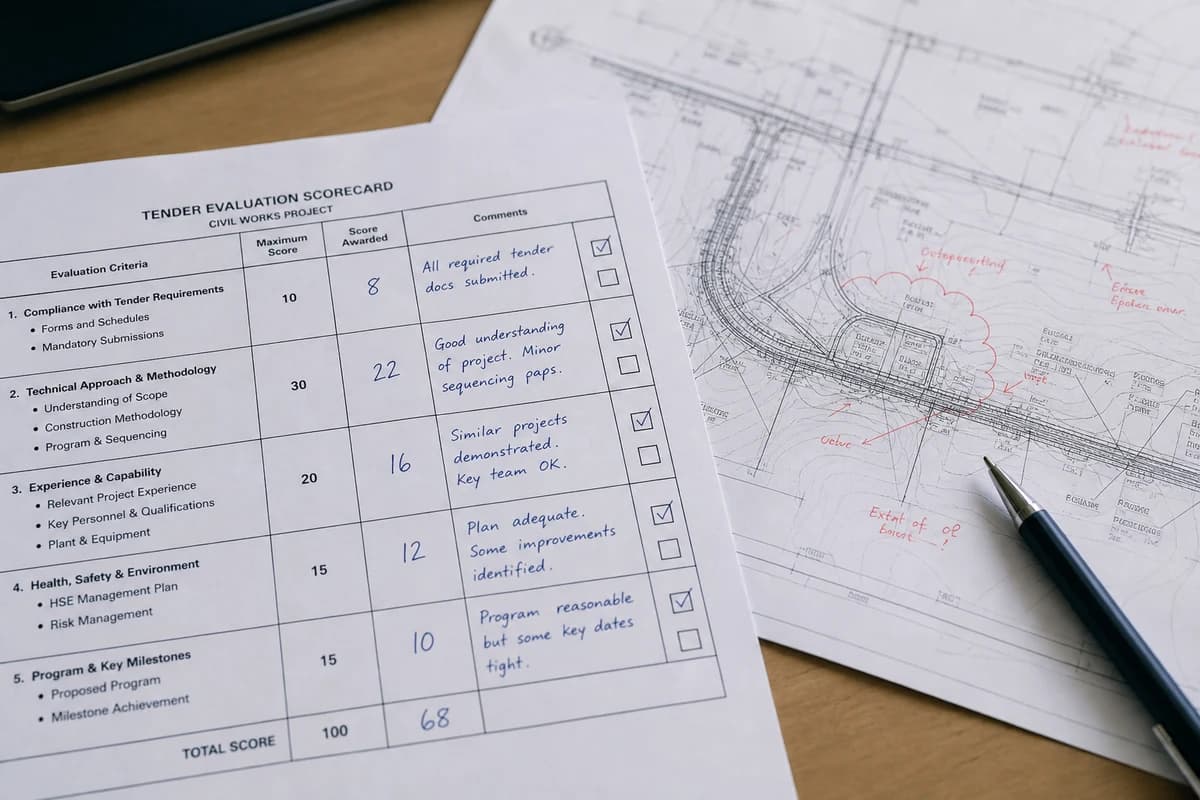
Write a short civil contractor checklist and weight it before envelopes open. Include inclusions and exclusions, temporary works ownership, utility assumptions, hold points, WHS evidence you truly require, and who speaks for programme risk.
Refuse to advance tenders that leave those lines blank or answer with marketing language. A scorecard that only rewards polished writing rewards the wrong firm.
Appointment themes that sit beside evaluation scoring are covered in how to choose a civil contractor in NSW—use that guide for capability proof once tenders pass the shared checklist.
What should be included in a civil works tender?
A civil works tender should give every tenderer the same inclusion map—not only a price schedule. At minimum include: scoped drawings and revision list; survey and geotechnical extracts; known services and access constraints; design vehicle or load assumptions; provisional items and who owns soft-spot or contamination unknowns; temporary works ownership; ITP or hold-point expectations; programme milestones; and a clear exclusions list.
Ask tenderers to restate inclusions, exclusions, and assumptions in their own words so you can compare like-for-like. If the pack is incomplete, you are not evaluating contractors—you are ranking how aggressively each firm priced the gaps.
Strengthen incomplete briefs with what to include in a civil project inquiry before you issue the tender, then score returns against the shared gates above.
Civil tender requirements: method and assumptions over slogans
Ask every tenderer to restate the scope, list provisional items, and publish assumptions about weather, utilities, and access. Civil tender requirements that demand only a price invite protective or opportunistic answers.
Score method statements for how they handle wet weather holds, soft spots, and interface with roads or following trades. Vague “standard industry practice” responses hide the risk you will pay later.
For package anatomy when checking whether method matches earthworks reality, cross-check earthworks contractor NSW: bulk, detailed and site preparation against what the tender claims it will prove on site.
Score project delivery controls, not only plant capacity
Project delivery controls worth scoring include ITP logic, hold-point ownership, non-conformance close-out habits, and how supervision reports deviations. Plant numbers without records tell you mobilisation speed—not quality under pressure.
Ask for a sample QA artefact redacted from a comparable package. If a tenderer cannot show how controls operate, treat brochure safety text as incomplete.
Assurance themes vendors often reference are summarised in NEXTGEN’s delivery FAQ and about NEXTGEN pages—require project-specific answers in the tender, not links alone.

Civil procurement NSW traps that skew comparisons
Civil procurement NSW processes skew when addenda arrive late, when one tenderer gets clarification answers others do not, or when evaluation weights change after prices are known. Publish weights with the tender and log clarifications to all parties.
Watch for apples-to-oranges packages: separable portions priced differently, excluded drainage, or provisional sums that absorb unknowns. Normalise those lines before you crown a winner.
Evaluation gate checklist before you appoint
Confirm every shortlisted return answers the same civil contractor checklist gates.
Assumptions and exclusions are listed explicitly and comparable across tenderers.
Project delivery controls and sample QA evidence meet your civil tender requirements.
Price is compared only after scope and risk lines are normalised.
Clarifications were issued to all parties under the same civil procurement NSW rules.
When you are ready to brief NEXTGEN into a formal or selective process, send drawings and evaluation criteria through the contact pathway and review delivery shapes in the project showcase if comparable package evidence helps your scoring panel.