

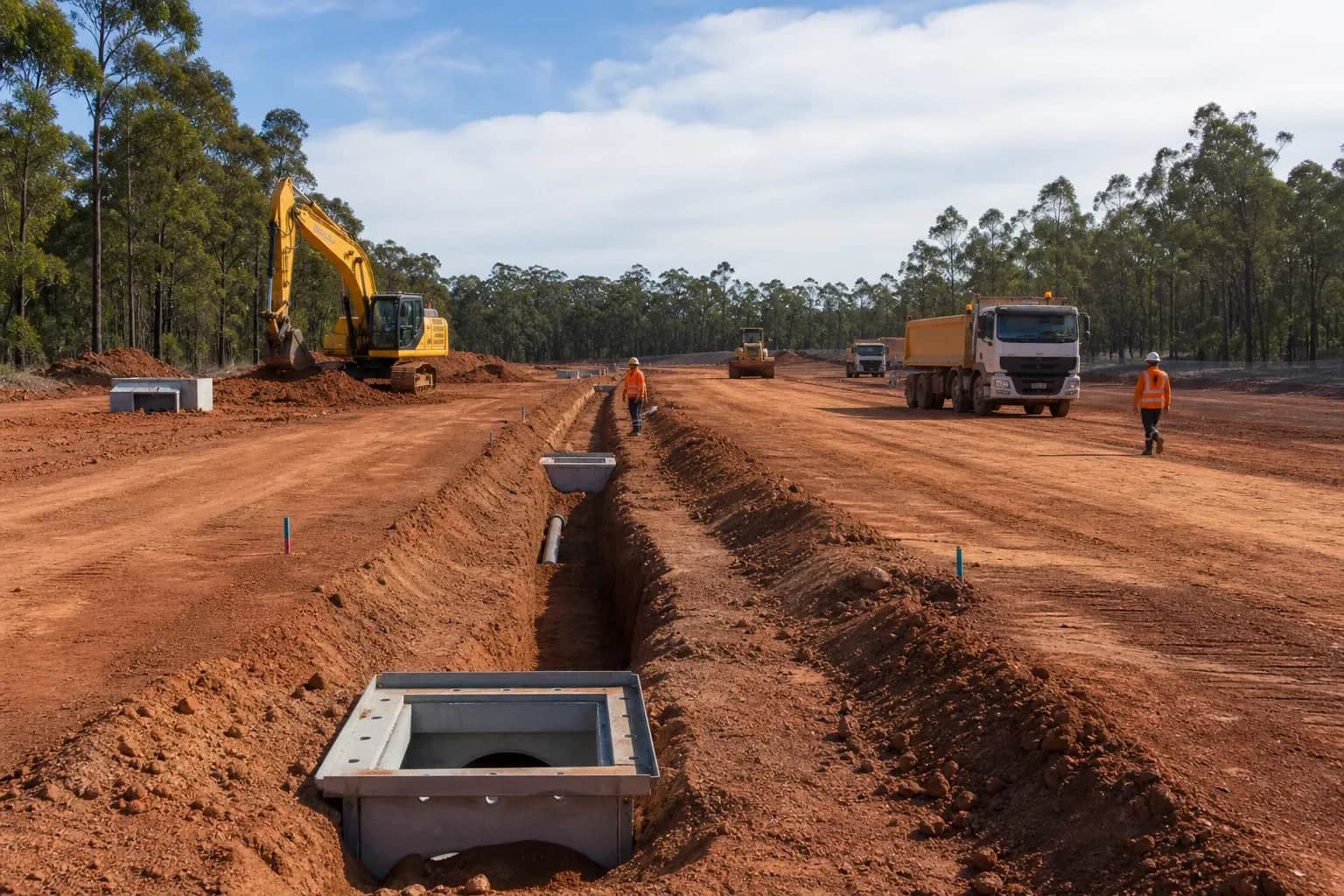
Why pavements fail when service corridors are planned too late
The practical answer for industrial projects is to plan service corridor civil works NSW as a sequence, not a separate scoping exercise. When pavements are built before stormwater drainage NSW outlets, trench corridors, and culvert installation NSW interfaces are settled, the corridor is left with soft edges, blocked outlets, and rework that delays the final seal.
A pavement layer cannot "solve" a corridor that still needs drainage changes or trench reinstatement. It can only hide the consequences—ponding, edge breakdown, and repeated asphalt cuts—until traffic and rain make the defects visible.
If you want a broader way to manage civil interfaces, start with civil infrastructure division and then lock utility and drainage decisions before pavement procurement is finalised.
Step 1—Map stormwater drainage NSW and outlet responsibilities before trenches
Start with the water story. Define where stormwater drainage NSW catchments collect, where outlets discharge, and what temporary diversions are required while trenches are open. Confirm that outlet levels and maintenance routes are feasible in construction—before you excavate and before you close formation with pavement layers.
A common industrial failure is split ownership: one team "sizes" pits and pipes, while another cleans drains, reinstates pavements, or manages sediment control. Service corridors should include a single interface register that records who verifies pit inverts, who maintains temporary drains, and who owns reinstatement after utility trenching NSW works.
Use NEXTGEN's guidance on what to confirm with a stormwater drainage contractor NSW to shape your corridor checklist for industrial sites.
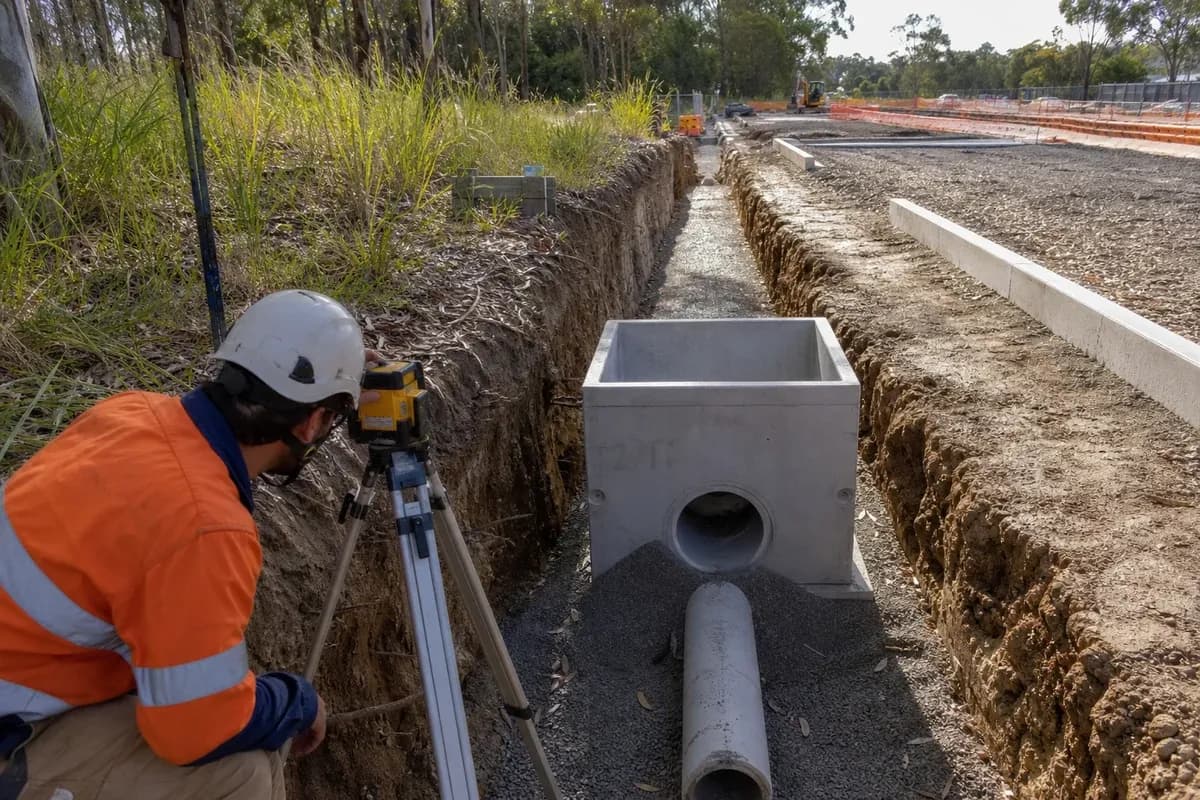
Step 2—Plan utility trenching NSW corridors with separations and cover
Utility trenching NSW must be planned around spacing, cover depth, bedding standards, and how services cross roads, pads, and culvert zones. "Approximate" routes are expensive in industrial corridors because there are multiple future tie-ins, traffic loads, and tight working windows.
Define trench sequencing relative to earthworks. For example, set the alignment that stays with formation proof, then plan bedding and backfill in lifts that can be reinstated without deforming the corridor edge. Where utilities cross a future pavement footprint, specify what will happen after backfill—testing, compaction proof, and what temporary surface will carry construction traffic.
For corridor-level thinking across services, review NEXTGEN's utility trenching contractor NSW guide and adapt the interface language for your industrial scope.
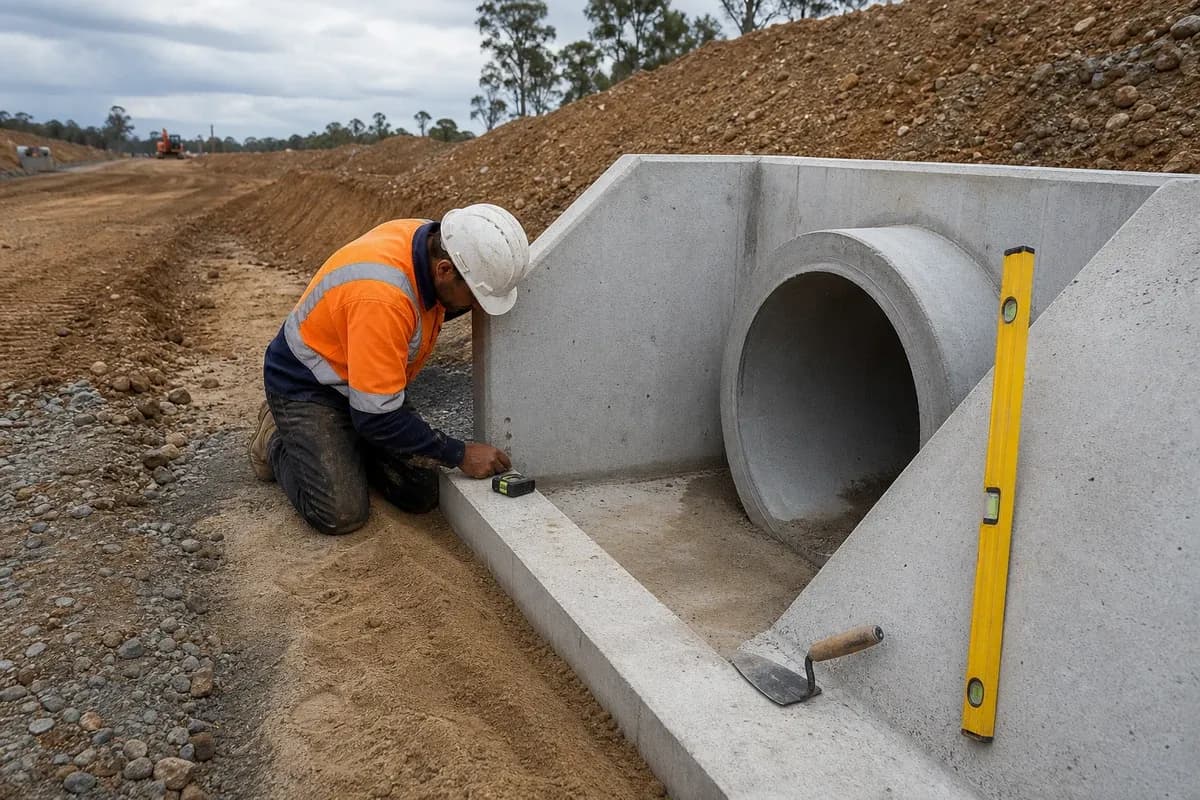
Step 3—Treat culvert installation NSW as a road and formation interface
Culvert installation NSW is not just a pipe or barrel. It is an interface structure that needs correct alignment, bedding, headwalls or end structures, and scour or outlet protection so water moves safely when pavements are already present or soon to be built.
Stage culvert installation NSW early enough that the road and pavement teams can follow the finished levels. If the culvert is discovered late, pavement crews either cut and reinstate layers or accept drainage changes after sealing, which typically leads to edge failure and repeated reinstatement.
Where culverts meet access and roadway interfaces, coordinate with culvert installation NSW: roads and access scope so your industrial service corridor corridor uses consistent interface rules.
Step 4—Protect road edges, pits and reinstatement boundaries through handover
Service corridors fail when the reinstatement boundary is unclear. Protect road edges, pit lids, kerb or table drain transitions, and any interface where utility trenching NSW closes and pavement layers will be built next. The corridor should show what is allowed to close, what stays open, and what must be proof-tested before sealing.
Build your corridor method around QA evidence. Require chainage-based records that link drainage outlets, trench reinstatement, compaction checks, and any non-conformance close-out. This evidence is what lets the civil drainage contractor and the pavement contractor agree that the corridor is truly ready.
If you need an assurance framework for what should be ready for practical completion, use NEXTGEN's delivery FAQ and bring those questions into your industrial corridor coordination meetings.
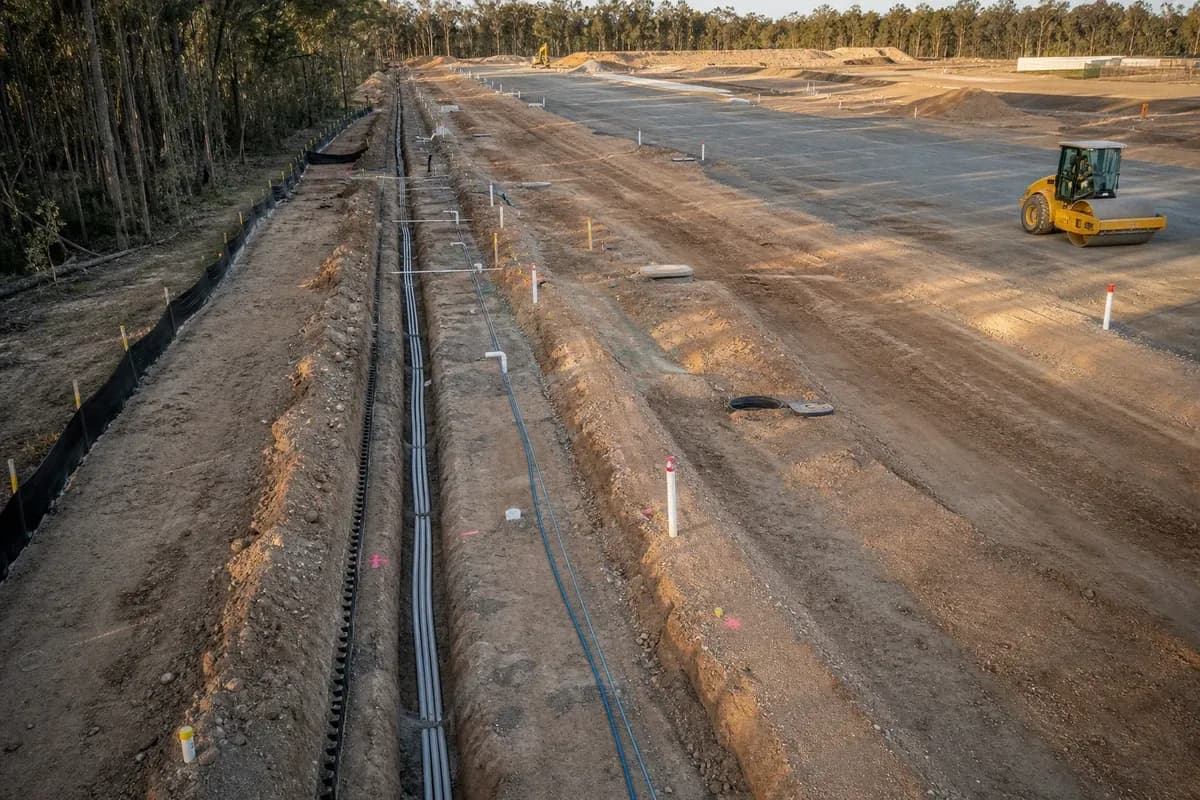
Step 5—Document service corridor handover records before pavements are locked
Before pavements are installed, document what was built. Service corridor civil works NSW handover should include drainage as-builts at outlets, trench records that show bedding and cover, and culvert installation NSW interface details where the corridor crosses roadways. Add photographic evidence of hold points at pits, junctions, and reinstatement boundaries.
Treat documentation as part of construction control, not a wrap-up task. When handover records are assembled while work is fresh, asset owners can verify that stormwater drainage NSW and utility trenching NSW decisions match the pavement levels and the operating intent.
When you are ready to brief a corridor scope, contact NEXTGEN with drawings, proposed corridor extents, known services and your pavement sequencing plan.
Checklist before you build pavements over industrial service corridors
Use this gate before pavements close the ground:
Have stormwater drainage NSW outlet locations and maintenance access been confirmed, including temporary diversions during trenching?
Are utility trenching NSW corridors aligned with formation and stated separations and cover depths, including crossings under future pavement zones?
Has culvert installation NSW been verified for structure-level alignment, outlet protection and road or formation interface levels?
Do reinstatement boundaries include QA evidence for compaction and drainage transitions, with non-conformances closed to an agreed standard?
Can you produce corridor handover records that link as-builts, test results, and hold-point evidence to the chainages in the drawings?
For a wider view on sequencing across disciplines, review related delivery examples in project showcase and align your corridor method with your broader industrial delivery programme.